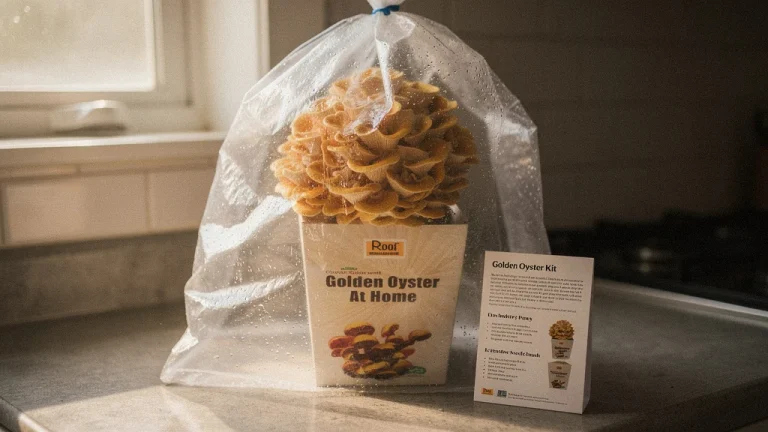
Learning how to grow mushrooms at home is one of those skills that sounds intimidating until the day your first oysters pin, and then you wonder why you waited. My wife and I started with a single mail-order kit on a closet shelf, and we have been hooked ever since. Mushrooms sit at the center of something bigger too. They feed forests, break down pollution, show up in our medicine, and lately they are even showing up in our packaging. This guide walks you through the easy way to start, the books that taught us most of what we know, and the gear that is actually worth the money.

A quick note before we dig in: some of the links below are affiliate links, which means we earn a small commission if you buy through them at no extra cost to you. We only recommend things we have grown with or read ourselves.
Why grow your own mushrooms?
Growing mushrooms at home is fun, and honestly easier than most people expect. You can do it outside in a shady bed or in a small closet inside, which makes it one of the few food crops that works in an apartment with no yard and almost no light. Mushrooms do not need a garden. They need humidity, fresh air, and something to eat that most of us throw away, like coffee grounds or straw.
It is also an exciting time to pay attention to fungi. Most of us grew up barely aware of the reach mycelium has in our lives. The usefulness of mushrooms goes way past the dinner table. There are culinary and medicinal uses, psychological and spiritual research, and industrial products like hats, clothing, and shipping packaging grown from mycelium instead of plastic. Once you see that list, growing a few oysters on your shelf starts to feel like joining something.

What is mycelium?
Mycelium is the vegetative part of a fungus, a network of fine white filaments that spreads through soil, wood, or whatever substrate the fungus is living in. When you see a mushroom, you are looking at the fruit of that network, the way an apple is the fruit of a tree. The network itself is the actual organism, and in some forests a single mycelial mat can cover acres.
Back in March 2020 we originally published this post to celebrate Fantastic Fungi Day, when the documentary Fantastic Fungi screened in more than 500 venues around the world. The film still holds up. It features award-winning director Louie Schwartzberg, renowned mycologist Paul Stamets, and conversations with a long list of scientists and foragers, and it is the single best hour and a half of intro education on the fungi kingdom I can point you to. The companion book became our coffee table fixture.
Paul Stamets said it better than we can:
“Louie and his team have accomplished an amazing task – with beautiful imagery, celebrating the quality of nature we have now. Fantastic Fungi is a film that serves to be a bridge of understanding to connect these ideas. By investing in these fungal networks we invest in the webs of life. Time is short. We need to bring this knowledge to the forefront of public consciousness.” PAUL STAMETS

If you would rather read than watch, this is the book version of the film, and it doubles as one of the best intros to how to grow mushrooms that I have come across:
Fantastic Fungi: How Mushrooms Can Heal, Shift Consciousness, and Save the Planet
by Paul Stamets, Louie Schwartzberg, Eugenia Bone

On the Fantastic Fungi website, the team lays out the different ways mushrooms can benefit our lives, and their list is worth stealing outright:
The seven pillars of the fungi kingdom
- Environmental and biodiversity. Fungi decompose, recycle, and feed forests.
- Foraging and culinary. From chanterelles to homegrown oysters on the pan.
- Innovation and solutions. Mycelium packaging, insulation, and mycoremediation of polluted soil.
- Culture and arts. Fungi in design, textiles, and history.
- Health and wellness. Immune-supportive compounds studied in species like turkey tail and reishi.
- Mental health and therapeutic. A fast-moving research area we follow with cautious interest.
- Consciousness and spirituality. The oldest human relationship with mushrooms of all.
If the health side of that list grabs you, this is the blend we keep in our own cabinet. Mushroom Immune Defense is a mix of mushroom mycelia and extracts from 16 of the most well-studied species of health-supportive mushrooms.
How to grow mushrooms at home, step by step
Here is the honest, unglamorous truth: the simplest way to start learning how to grow mushrooms is a kit. A kit is a bag or block of sterilized substrate that is already colonized with mycelium. You cut a hole, keep it humid, and mushrooms show up within about two weeks. It removes every variable except watering, which is exactly what a beginner wants.
Step 1: start with a beginner kit
Oyster mushrooms are the classic first crop because they are fast, forgiving, and tolerate the imperfect humidity of a normal house. Pink, gold, and blue oysters all fruit happily indoors. Lion’s mane is another good choice and cooks up like seafood. Pick the one you actually want to eat, because you will get several flushes out of a single block.
Step 2: give it the right spot and humidity
Put the block somewhere with indirect light and good airflow, not a sealed dark cabinet, since mushrooms need some light to orient and fresh air to form normal shaped caps. Mist the cut area with water two to four times a day, or slip a loose plastic tent over it to hold humidity. Dry air gives you cracked caps; soggy stagnant air invites mold. Aim for the misted, not dripping, middle ground.
Step 3: harvest and go again
Pick your mushrooms when the caps begin to flatten out, twisting the whole cluster off at the base. Then keep the block moist, because the same substrate usually gives you a second and sometimes a third flush over the following weeks. When it finally stops producing, the spent block is compost gold.
Beyond kits: logs, beds, and foraging
Once a kit has shown you the rhythm, the next step is scaling up. Shiitake plugs hammered into fresh hardwood logs fruit for years with almost no work past the initial inoculation. Wine cap mushrooms can be spawned straight into a shaded garden bed of wood chips, and they come back each season. Foraging is the other path, and I will give you the same warning every forager gives: never eat a wild mushroom unless an expert has identified it in person. If you want to go deep on any of this, the books below are where we would send you.

Top 5 beginner mushroom growing kits


Top 7 inspiring books on mushrooms
These are the titles that took us from “what is mycelium” to running logs and beds of our own. Between them you get cultivation, identification, cooking, medicine, and the big picture ecology.


Other mushroom growing supplies
If you would rather run your own bags from scratch than buy pre-colonized blocks, this is the setup we would start with.

All in One Mushroom Grow Bag (2 Pack)
- Fully sterilized and ready to inoculate
- Grow bag has a self healing injection port
- No need to transfer to a secondary bulk substrate
- Five micron filter patch on bag for gas exchange
- Substrate can be fruited directly in the bag
Four Quart Jars of Sterilized Rye and Four One Pound Bags of Manure Based Substrate

Highly rated mushroom supplements
I am a skeptic about most supplements, mushrooms included, so take this section as a starting point for your own research rather than medical advice. That said, these are the products with the strongest reputations and cleanest labeling that we found while stocking our own shelf.


Do mushrooms really help your health?
There is real research here, and there is also a lot of hype, and the two get blended together in ways that drive me a little nuts. What I can say is that culinary mushrooms are a genuinely good whole food, and that early studies on things like brain health are intriguing. A Medical News Today piece on mushrooms and brain health is a fair, non-hyped summary if you want the actual state of the science. Our own rule is simple: mushrooms on the plate regularly, supplements only occasionally, and no expectations of miracles from either.
One more thing worth saying. Fungi taught us to look at the whole kitchen differently. Once you start growing mushrooms and fermenting your own food, the pantry becomes a workshop. If that sounds like your kind of fun, read our guide to making your own probiotics at home, try our vegetarian kimchi recipe, and for a simpler first ferment, nothing beats a jar of homemade sauerkraut. Greens growers should see our guide to growing sunflower sprouts and our rundown of why microgreens are worth the shelf space.

Disclaimer: The information provided on this website does not, and is not intended to, constitute medical or legal advice; instead, all information, content, and materials available on this site are for general informational purposes only. Information on this website may not constitute the most up-to-date legal or other information. This website contains links to other third-party websites. Such links are only for the convenience of the reader, user or browser.
Readers of this website should contact their doctor or physician to obtain medical advice with respect to any particular matter. No reader, user, or browser of this site should act or refrain from acting on the basis of information on this site without first seeking advice from your doctor. The views expressed at, or through, this site are those of the individual authors writing in their individual capacities only, and are not those of their respective employers, Fantastic Fungi or any associated organization or individual. All liability with respect to actions taken or not taken based on the contents of this site are hereby expressly disclaimed. The content on this posting is provided “as is;” no representations are made that the content is error-free.
FAQ
What is the easiest mushroom to grow at home? Oyster mushrooms, no contest. They grow fast, they forgive imperfect humidity, and a basic kit fruits in about two weeks. Lion’s mane is the runner-up if you want something that cooks like scallops.
Do you need a dark room to grow mushrooms? No. Mushrooms need some indirect light to know which way is up, and they fruit better with fresh air than in a sealed dark box. A shelf near a window with a few daily mistings is plenty for a kit.
How long does it take to grow mushrooms from a kit? Most kits pin within a week or two of first cutting the bag and give you two or three flushes over a month or so. Logs take longer to start but keep producing for years.
Is it safe to eat mushrooms I forage myself? Only if an expert has confirmed the identification in person, every single time. Some deadly species look almost identical to edible ones, and no app or single photo is a safe substitute. When in doubt, leave it in the woods.